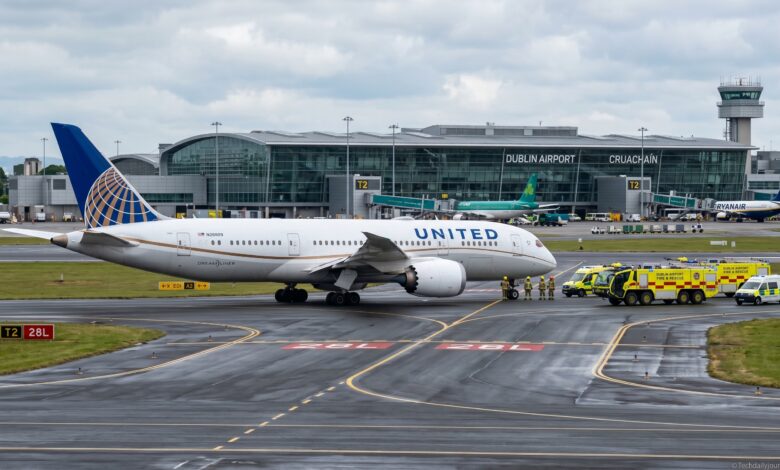
On October 30, 2025, United Airlines Flight UA109, a transatlantic service connecting Munich, Germany (MUC) to Washington Dulles International Airport (IAD), made headlines when it was diverted mid-flight to Dublin Airport (DUB). The flight, operated by a Boeing 787‑8 Dreamliner, had departed Munich in the early afternoon, following a typical transatlantic schedule. Passengers and aviation observers were surprised when the aircraft performed a sharp turn over the Atlantic, ultimately landing in Dublin rather than continuing to its final destination. This incident, while disruptive, highlights the layers of safety, planning, and operational decision-making inherent in modern commercial aviation. Diversions like UA109’s are not rare but are essential procedures to protect passengers and crew during unexpected situations.
The Timeline of Flight UA109 and Its Diversion
Flight UA109 took off from Munich at approximately 12:14 Central European Time, bound for Washington, D.C., on what would normally be a roughly nine-hour journey. About three hours into the flight, while cruising over the Atlantic Ocean, the aircraft initiated a course reversal, redirecting toward Ireland instead of the United States. The decision to divert was made due to a medical emergency on board, although the specific details of the passenger or crew member involved have not been publicly released. United Airlines confirmed that the flight landed safely at Dublin Airport, where emergency responders and medical personnel were standing by to assist. No serious injuries were reported, and passengers were later accommodated on a continuation flight to Washington D.C.
This diversion illustrates the high degree of judgment exercised by airline crews when navigating unexpected events. Captains are empowered to make decisions that prioritize safety over schedules, relying on onboard medical kits, AED devices, and remote medical consultation if necessary. In the case of UA109, the flight’s midpoint over the Atlantic made choosing a diversion airport with sufficient infrastructure, such as Dublin, an essential factor in the decision-making process.
Medical Emergencies as a Leading Cause of Diversions
Medical incidents are among the most common reasons for unscheduled flight diversions, especially on long-haul routes crossing oceans or remote regions. Conditions such as heart attacks, seizures, severe allergic reactions, or sudden illnesses can necessitate immediate landing. Commercial aircraft are equipped to stabilize many emergencies in flight; however, some situations require ground-based medical intervention. Flight UA109’s diversion demonstrates this principle: a prompt landing ensured that the affected individual could receive specialized care quickly, which may not have been possible if the flight had continued uninterrupted to Washington.
Airlines maintain strict protocols for in-flight medical events, including prioritizing access to volunteer medical professionals among passengers, continuous monitoring, and communication with ground-based medical advisors. Decisions to divert are guided not only by the severity of the medical situation but also by the proximity of suitable airports capable of handling wide-body jets and medical emergencies, as well as weather and airspace considerations along the route.
Dublin Airport: Strategic Diversion Hub
Dublin Airport has long been recognized as a key diversion point for transatlantic flights. Its location on the western edge of Europe allows aircraft crossing from continental Europe or North America to land safely in emergencies. The airport is equipped with emergency medical services, rapid-response fire teams, and full operational support, making it a preferred option for airlines dealing with unscheduled events. In UA109’s case, Dublin’s readiness ensured that passengers and crew could be safely accommodated, and any necessary medical treatment could be delivered immediately. The airport’s coordination with airline operations teams also facilitated a smooth continuation of the flight after the emergency was addressed.
Airline Safety Culture and Diversion Protocols
The UA109 diversion is emblematic of the safety-first philosophy that governs modern aviation. Airlines empower pilots and crew to make real-time decisions that prioritize the health and security of passengers. While schedule adherence, cost considerations, and passenger convenience are always important, they are secondary to safety during emergencies. Diversions, whether for medical, mechanical, or operational reasons, are standard operating procedures designed to minimize risk.
Flight diversions also illustrate the coordination between the airline, air traffic control, and airport authorities. Communication is critical: ATC must clear the diverted aircraft’s approach, coordinate runway availability, and ensure that ground teams are prepared for rapid response. This ensures that even in high-stress situations, safety and operational efficiency are maintained.
Impact on Passengers and Airline Operations
For passengers, diversions are inherently disruptive. Those on UA109 experienced a mid-flight course change, temporary uncertainty, and delays in reaching Washington. Airlines respond by providing information, arranging onward connections, and offering accommodations or refreshment support if delays are extensive. While passengers may initially perceive diversions as alarming, aviation experts emphasize that these events demonstrate effective safety protocols in action, rather than equipment failure or catastrophic risk.
For airlines, diversions also have logistical implications. Adjusting crew schedules, rescheduling aircraft utilization, and managing connecting flights are all part of the operational impact. Nonetheless, these challenges are secondary to ensuring that passengers and crew are protected during an unexpected emergency.
Other Causes of Flight Diversions
While UA109’s diversion was medical in nature, flights are diverted for a wide range of reasons. Mechanical issues, including engine anomalies or instrument warnings, can necessitate unscheduled landings. Severe weather, such as thunderstorms, turbulence, or volcanic ash clouds, may also force pilots to divert. Additionally, security concerns, hazardous materials incidents, or passenger safety issues can require immediate course adjustments. The aviation industry maintains detailed protocols for all these contingencies to protect lives while minimizing disruption.
Aviation Industry Insights and Safety Implications
The UA109 incident highlights several broader insights about modern aviation:
- Captains are trained to prioritize human life over schedules, making decisive calls when conditions warrant.
- Airports like Dublin serve as critical support hubs, providing infrastructure for emergency landings.
- Airlines maintain medical, operational, and communication protocols to handle unscheduled events safely.
- Diversions are an accepted part of risk management, reflecting proactive measures rather than operational failure.
Furthermore, the UA109 diversion contributes to statistical and operational understanding for airlines. Data on diversion causes helps optimize flight planning, crew training, and emergency preparedness. Each event informs broader safety standards that improve outcomes across the industry.
Read More: Barbara Patrick: Life, Career, Personal Story, and Legacy
Conclusion
The diversion of United Airlines Flight UA109 on October 30, 2025, serves as a textbook example of aviation safety protocols in action. Promptly responding to a medical emergency at cruising altitude over the Atlantic, the flight crew demonstrated the effectiveness of decision-making, training, and coordination in a high-stakes environment. Dublin Airport’s preparedness, combined with United Airlines’ operational procedures, ensured that passengers and crew were protected and supported throughout the diversion. While such incidents may disrupt schedules, they reinforce the aviation industry’s core principle: the safety and well-being of passengers and crew always come first. UA109’s diversion underscores how international aviation combines planning, technology, and human judgment to respond to unforeseen events effectively, ensuring that long-haul flights remain safe across the globe.