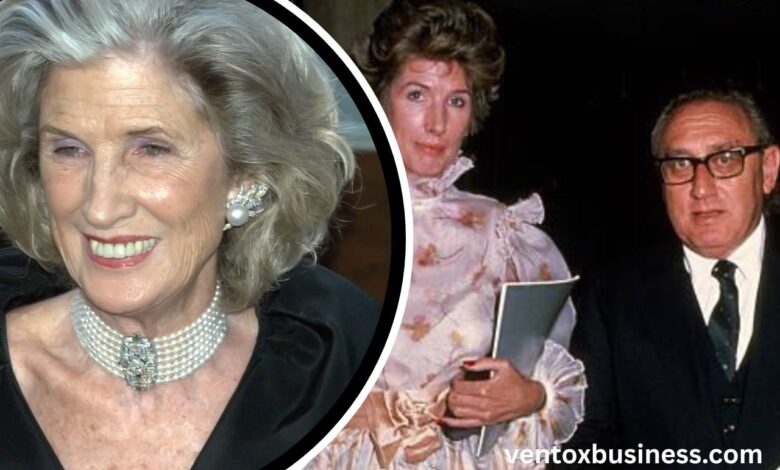
Nancy Kissinger, born Nancy Sharon Maginnes in 1934, has lived a life of intellect, influence, and discretion, carving a unique path in the worlds of politics, philanthropy, and diplomacy. Best known as the wife of Henry Kissinger, former U.S. Secretary of State, Nancy’s own achievements extend far beyond her marital association. From her early academic pursuits at Mount Holyoke College and the Sorbonne to her pivotal work as a political aide to Governor Nelson Rockefeller, she has been a quiet yet formidable presence behind major policy and philanthropic initiatives. Despite her public visibility, Nancy has carefully guarded her personal life, especially concerning her health, which has included significant medical challenges. This article explores her life, career, and reported health history in detail, highlighting both her public contributions and the private resilience that has defined her legacy.
Early Life and Family Background
Nancy Kissinger, born Nancy Sharon Maginnes on April 13, 1934, in New York City, emerged from a family of distinction and education. Her father, a lawyer with a keen interest in sports, and her mother, Agnes McKinley, cultivated an environment that valued intellect, culture, and civic engagement. Nancy spent her formative years in White Plains, New York, where she attended The Masters School in Dobbs Ferry, an institution known for nurturing academic excellence and leadership qualities. Her education provided a strong foundation for her later work in political research and public service.
Nancy went on to pursue higher education at Mount Holyoke College, one of the most prestigious women’s colleges in the United States. She graduated in 1955 with a Bachelor of Arts in History, reflecting her deep interest in global affairs and socio-political systems. Further enriching her academic experience, she studied at the Sorbonne University in Paris, immersing herself in international perspectives and cultivating a network of global contacts that would influence her professional trajectory. Nancy’s early life was marked by intellectual curiosity, an exposure to global ideas, and a commitment to public service.
Career Beginnings and Political Engagement
Nancy Kissinger’s early professional life was characterized by political research, philanthropic involvement, and advisory roles. She first made her mark as a research assistant for Harvard professors and subsequently joined state government initiatives in New York. Her career took a significant turn when she became an aide to Governor Nelson Rockefeller, recommended by Henry Kissinger, her future husband. Her role under Rockefeller involved extensive research, policy analysis, and contributing to the Commission on Critical Choices for Americans, a think tank that evaluated domestic and international policy priorities in the 1960s and 1970s.
Her work demonstrated her analytical skills, understanding of international relations, and capacity to navigate complex bureaucratic environments. While she did not occupy elected office, Nancy’s contributions were instrumental in shaping strategic recommendations and policy discussions, reflecting the influence she wielded behind the scenes. Through these roles, she developed expertise in political strategy, philanthropy, and research management—skills that would later define her public persona as a key supporter and advisor to influential leaders.
Marriage to Henry Kissinger and Public Life
On March 30, 1974, Nancy Maginnes married Henry Kissinger, then serving as the U.S. Secretary of State and former National Security Advisor. Their union brought Nancy into the global diplomatic spotlight, although she remained a figure of discretion rather than a public policymaker. Throughout their marriage, she accompanied Kissinger on numerous state visits, diplomatic missions, and international forums, providing personal and professional support.
Nancy’s marriage enhanced her visibility and underscored her influence in political and philanthropic circles. She became known not only as a supportive spouse but also as a cultivated, intelligent figure capable of navigating the complex social and diplomatic landscapes of global leadership. Her public appearances, often alongside Henry Kissinger at formal state dinners and international events, cemented her reputation as a prominent American social figure with ties to global politics.
Health History and Medical Challenges
Nancy Kissinger’s health history is marked by several significant medical events, which have occasionally been discussed in public records, although she maintained a preference for privacy. Notably, she underwent major stomach surgery in 1976, during which approximately 40% of her stomach was removed due to chronic ulcers. This surgical procedure was reported in several archival newspapers and highlighted her resilience in facing serious medical challenges.
In 1994, Nancy was hospitalized for undisclosed medical reasons, reflecting the recurring nature of health issues that required professional attention but were shielded from public scrutiny. The following year, in 1995, she underwent colon surgery at Massachusetts General Hospital, which was also conducted with a high degree of confidentiality. These incidents demonstrate a pattern of serious but non-public health challenges.
Despite these significant medical events, there is no credible documentation confirming a long-term disability. Her medical interventions, while substantial, appear episodic and did not publicly categorize her as having a functional limitation affecting her daily life. Nancy’s insistence on privacy means that details of her health, including any chronic conditions or lasting impairments, remain largely speculative. Nonetheless, these health challenges illustrate the reality of serious medical conditions in high-profile individuals and how privacy considerations often influence public knowledge.
Privacy and Media Perception
Throughout her life, Nancy Kissinger has maintained a discrete public persona, especially concerning her health and personal matters. Media coverage has often emphasized her elegance, intelligence, and supportive role, rather than personal vulnerabilities or medical details. Reports of her surgeries and hospitalizations were typically brief and factual, with limited elaboration, reflecting her preference for discretion.
Her approach to privacy underscores a broader theme regarding public figures and the management of personal health information. In an era when privacy norms were less codified than today, Nancy’s careful management of public disclosure exemplifies a strategy to protect personal dignity while participating in high-profile political and social arenas.
Philanthropy and Influence
Beyond her roles as a researcher, aide, and spouse of a prominent political figure, Nancy Kissinger engaged extensively in philanthropic and social initiatives. She supported educational, cultural, and policy-driven projects, often leveraging her network to promote international understanding and humanitarian efforts. Her philanthropic work, although less publicized than that of other social figures, contributed to meaningful advancements in global diplomacy and social welfare initiatives.
Nancy’s influence in philanthropy was complemented by her social presence, often hosting gatherings, conferences, and events that convened policymakers, academics, and cultural leaders. Her work in these spheres reflected her ability to bridge professional expertise, personal commitment, and strategic vision, highlighting her unique contribution to American political and philanthropic life.
Understanding Health and Disability in Public Figures
When examining historical figures like Nancy Kissinger, it is important to differentiate between medical conditions, chronic illnesses, and disability. A disability, by standard definitions, involves a long-term physical or mental impairment that substantially limits major life activities. Nancy Kissinger’s reported health events, including stomach and colon surgeries, indicate serious medical challenges but do not establish a publicly recognized disability status.
This distinction is crucial, particularly when discussing the intersection of public life, health privacy, and media reporting. High-profile individuals often experience intense scrutiny, yet privacy norms, especially regarding medical information, can obscure the extent and nature of health challenges. Nancy Kissinger’s case exemplifies this tension between public curiosity and personal privacy.
Legacy and Public Image
Nancy Kissinger’s legacy is intertwined with her roles as a researcher, political aide, philanthropic supporter, and spouse of Henry Kissinger. Standing at an estimated 6 feet tall, she was often noted for her commanding presence in both diplomatic and social settings. Her intelligence, poise, and discretion contributed to her enduring reputation as a prominent figure in American social and political circles.
While her medical history provides insight into her personal resilience and challenges, it is her professional contributions and philanthropic engagements that define her lasting impact. Nancy Kissinger represents an example of a public figure who balanced health challenges, discretion, and influence, leaving a nuanced legacy that encompasses intellect, service, and resilience.
Research and Related Themes
In exploring Nancy Kissinger’s life, several key themes emerge, relevant for understanding her biography in depth:
- Nancy Kissinger’s health and medical history, including stomach and colon surgeries.
- Her career as a political aide to Nelson Rockefeller and her contribution to policy research.
- Philanthropic and social initiatives, demonstrating her broader influence beyond formal positions.
- Marriage to Henry Kissinger, situating her within the context of global diplomacy and international relations.
- Privacy and media management, reflecting how public figures negotiate personal disclosure, particularly regarding health.
- Public perception and legacy, emphasizing intellect, poise, and professional contributions over personal vulnerabilities.
These themes collectively highlight her multifaceted life, emphasizing both public achievements and private resilience.
Read More: Jean Goebel: Life, Legacy, and Influence
Conclusion
Nancy Kissinger’s life is a testament to discretion, intellect, and influence. From her early years in New York City to her roles in political research and philanthropy, she carved out a significant presence in American public life. Her marriage to Henry Kissinger amplified her visibility but did not define her individual contributions, which were grounded in policy, research, and philanthropy.
Although she faced serious medical challenges, including stomach and colon surgeries, there is no public evidence that she lived with a formal disability. Her approach to privacy ensured that details of her health remained largely confidential, exemplifying the delicate balance between personal dignity and public curiosity.
Nancy Kissinger’s legacy is ultimately one of resilience, influence, and discretion, illustrating the complexities of being a public figure with private challenges, and highlighting the interplay between health, public perception, and enduring societal impact.